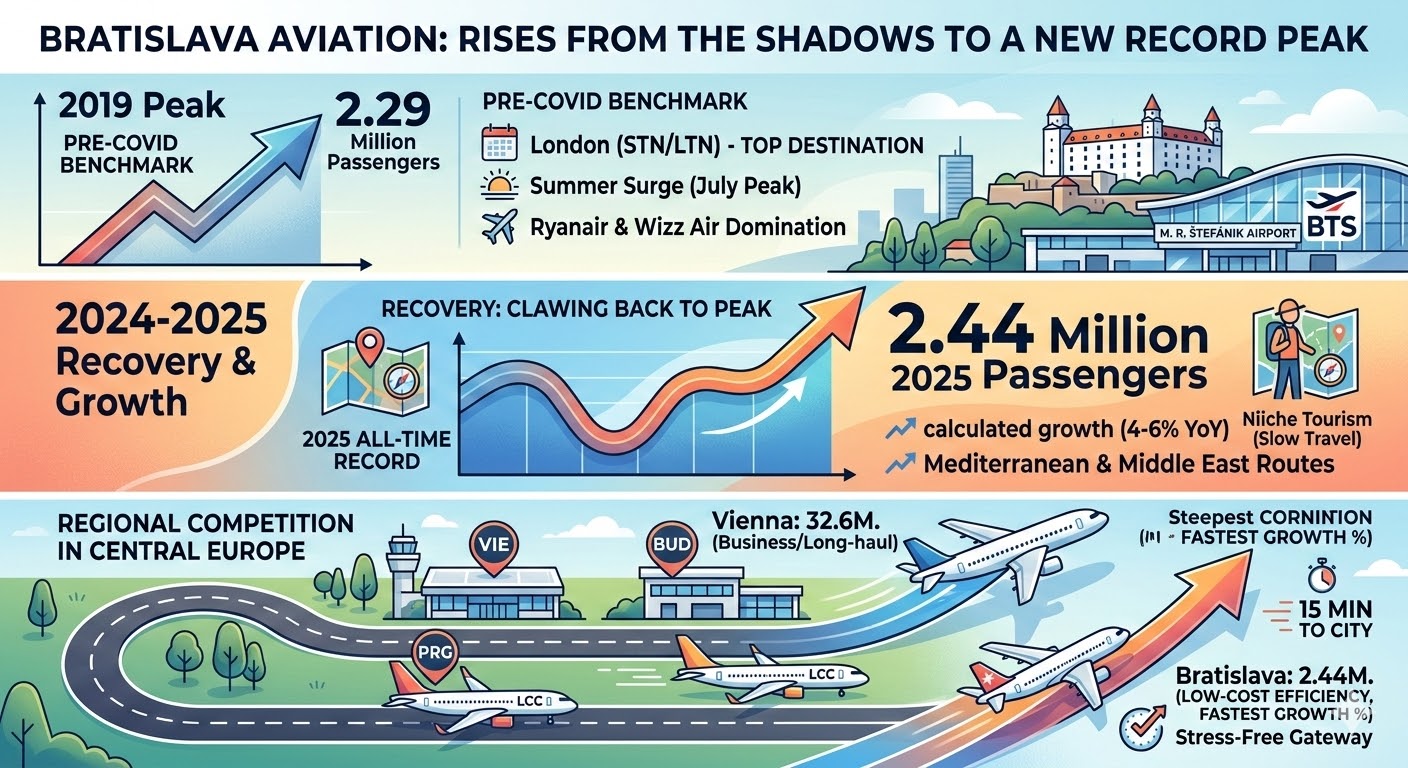
The landscape of Central European aviation has shifted dramatically over the last half-decade. For M. R. Štefánik Airport (BTS) in Bratislava, the journey from the pre-pandemic highs of 2019 to the current operational realities of 2024 and 2025 reveals a story of resilience, intense regional competition, and a strategic shift in how the Slovak capital markets itself to the world.
The 2019 Benchmark vs. The 2024-2025 Reality
In 2019, Bratislava was riding a wave of record-breaking expansion. The airport welcomed approximately 2.29 million passengers, fueled by a booming low-cost carrier market and a surge in city-break tourism. At that time, the trajectory seemed limitless. However, the global pause that followed necessitated a total reset of the aviation clock.
By 2024, the “recovery phase” transitioned into a “new normal.” Data from the past year shows that Bratislava has successfully clawed back the vast majority of its pre-COVID volume. While it hasn’t yet shattered the 2019 ceiling, the quality of traffic has evolved. We are seeing a 2025 landscape where passenger numbers are stabilizing around the 2-million mark, but with a higher percentage of year-round scheduled routes compared to the heavy charter reliance of five years ago.
According to the official Bratislava Airport traffic reports, the growth in 2025 is driven by a diversified portfolio of destinations, particularly strengthening ties with Mediterranean hubs and Middle Eastern connections that were less prominent in 2019.
The Regional Struggle: Fading or Flourishing?
The most common critique of Bratislava’s aviation sector is its proximity to Vienna International Airport (VIE). With Vienna located just 40 kilometers away, the competition is existential. While Vienna’s sky-high comeback and 2025 tourism boom attract the “Big Three” alliance carriers and massive long-haul hauls, Bratislava has had to find a different way to survive.
Similarly, Budapest and Prague have solidified their status as “Tier 1” European destinations, often leaving Bratislava out of the primary itinerary for trans-Atlantic travelers. However, Bratislava is not “fading”—it is specializing. While Vienna serves the global elite and long-haul business sectors, Bratislava has doubled down on being the most efficient, low-cost entry point into the Central European region.
Why Do People Choose Bratislava in 2025?
The reasons travelers choose Bratislava today differ slightly from the motivations of 2019. The city has moved beyond being just a “cheap alternative” to Vienna and has developed its own specific draws:
- The “Stress-Free” Gateway: In an era of massive airport queues and lost luggage at major hubs, Bratislava offers an “in-and-out” experience. Travelers can often get from the plane to the city center in under 30 minutes—a feat nearly impossible in Prague or Budapest.
- The Gateway to the Tatras and Beyond: For many, Bratislava is the starting point for Slovak nature tourism. The 2025 trend toward outdoor and sustainable travel has benefited Slovakia, with the capital acting as the primary logistical base for those heading to the Carpathian mountains.
- Affordability in an Inflationary Market: As prices in Prague and Vienna soar, Bratislava remains one of the most budget-friendly capitals in the Eurozone. This economic reality continues to pull in the Gen Z and millennial demographic through 2024 and 2025.
Are Other Slovak Airports Growing?
While Bratislava handles the lion’s share of traffic, it is not a monopoly. The decentralization of Slovak aviation is a key part of the 2025 strategy:
- Košice (KSC): The star performer of Eastern Slovakia. Unlike Bratislava, which competes directly with Vienna, Košice has successfully attracted legacy carriers like LOT and Austrian Airlines, serving as a vital link for the burgeoning IT sector in the east.
- Poprad-Tatry (TAT): This airport remains a niche player, primarily welcoming winter sun-seekers and hikers. Its 2024-2025 numbers show a high dependency on seasonal charters, yet it remains an essential asset for High Tatra tourism.
- Piešťany (PZY): Though much smaller, this airport has found success in the “health tourism” sector, bringing in visitors specifically for the world-renowned spa treatments in the region.
Conclusion: A Smarter Kind of Growth
Comparing 2019 to the 2024-2025 period shows that Bratislava has traded “raw volume at any cost” for “strategic, sustainable growth.” It may not be the giant of the Danube, but it has proven that there is a significant market for a capital city that is accessible, affordable, and human-scaled.
As we look toward the remainder of 2025, the influx of passengers suggests that Bratislava has successfully navigated the shadow of its larger neighbors, carving out a permanent—and growing—place in the Central European sky.


